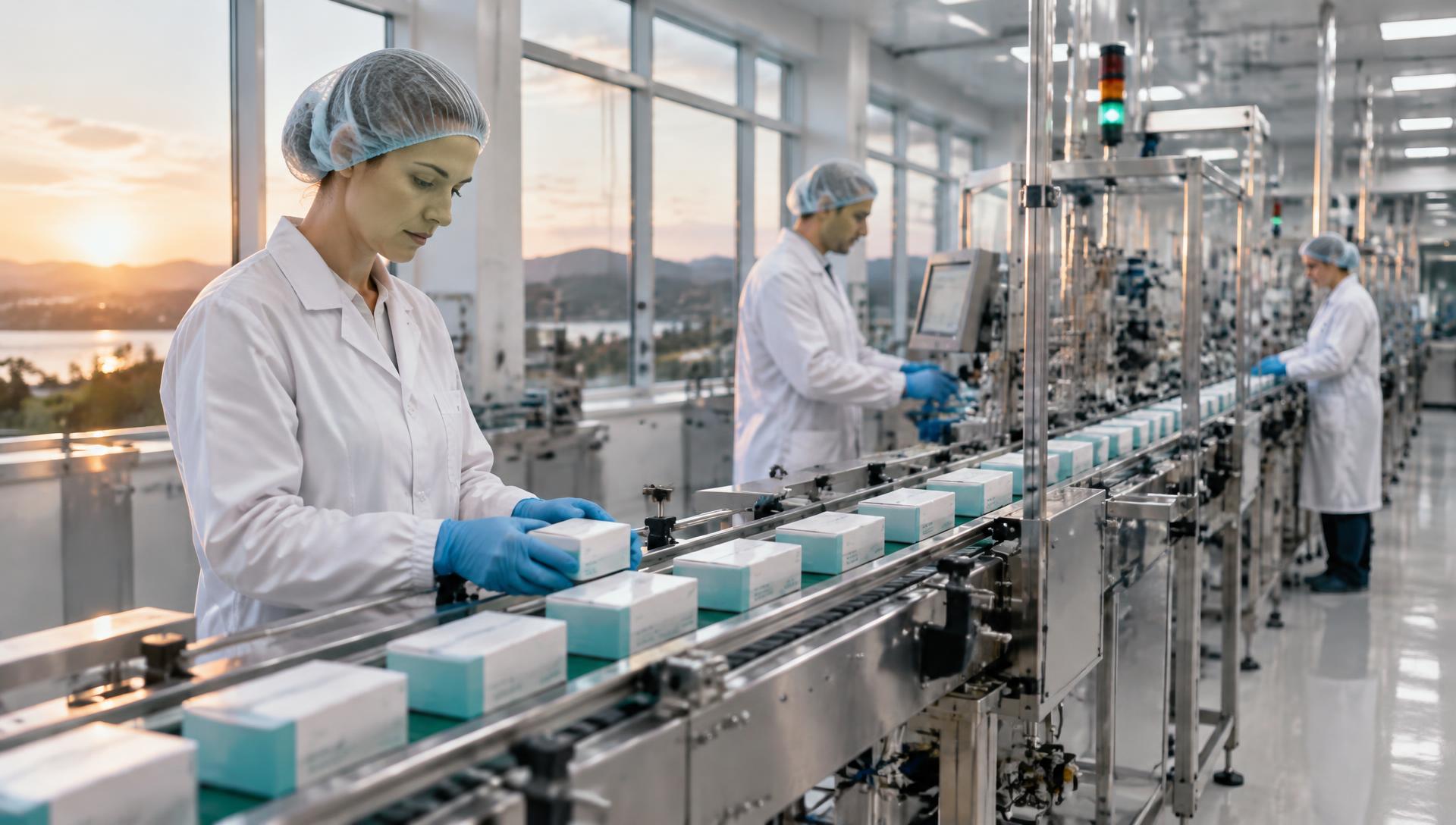
You've probably heard the line that Ireland makes '60% of Europe's medicines'. Nobody can stand that figure up. But the real, sourced numbers for 2025 and 2026 are striking enough on their own.
The exports: a record-breaking year
In 2025, Ireland's pharmaceutical exports reached €139 billion, according to a Goodbody report commissioned by the Irish Pharmaceutical Healthcare Association (IPHA) and published in March 2026. That was 53% of all Irish goods exports and 41% of modified gross national income (GNI*), the highest share on record.
It's a sharp jump from 2024, when medical and pharmaceutical exports stood at €99.9 billion, or about 45% of total goods exports, according to Central Statistics Office figures cited by IDA Ireland. Much of the 2025 surge came from one fast-growing category: hormones and their derivatives, the ingredients behind weight-loss drugs like Novo Nordisk's Ozempic and Wegovy and Eli Lilly's Mounjaro and Zepbound, which rose from €14 billion in 2024 to €51 billion in 2025, the Irish Examiner reported based on the same Goodbody report.
One market dominates that trade. Almost 40% of all Irish pharmaceutical exports to the United States in 2024 were destined for the state of Indiana alone, home to Eli Lilly's headquarters and one of the world's largest GLP-1 manufacturing operations. Lilly runs two Irish plants, in Kinsale, Co Cork, and Limerick, with the Kinsale site alone employing more than 1,300 people, the Goodbody report noted.
But this isn't a one-company story. New York-headquartered gene therapy firm MeiraGTx opened a commercial-scale manufacturing facility in Shannon in 2025, its first Irish site, aimed at producing treatments spanning inherited vision loss to neurological conditions such as Parkinson's disease, according to IDA Ireland. Rory Mullen, IDA Ireland's head of biopharma, said the country has seen 'huge amounts of investment in biologics over the past 10-15 years', with about €12 billion committed specifically to biologics drug substance and drug product facilities.
Eli Lilly has kept adding to that footprint: in early 2025 it announced plans to invest more than €400 million in a new greenfield facility for biologic active ingredients in Limerick, on top of its existing Kinsale and Limerick sites, IDA Ireland said. Japan's Takeda has also moved into more advanced manufacturing here, opening a commercial-scale cell therapy production facility outside Dublin as part of a €36.4 million investment - a sign that Irish plants are increasingly making living-cell treatments rather than just conventional tablets and capsules.
How many plants, and who is here
The scale behind those figures is plain. Ireland is home to more than 90 pharmaceutical companies and around 50 FDA-approved manufacturing plants, according to IDA Ireland, the state's inward investment agency, in a July 2025 briefing. Nine of the world's top 10 pharmaceutical companies by revenue have significant manufacturing or operational bases here.
IDA Ireland also puts Ireland as the world's third-largest exporter of pharmaceuticals, a ranking it attributes to the country's regulatory track record with the US FDA and the European Medicines Agency, its 12.5% corporation tax rate, and a large English-speaking, science-qualified workforce.
Employment across pharma manufacturing and related activities stood at around 75,000 people in 2025, with 28,000 of those directly in manufacturing, according to the Goodbody/IPHA report. Ibec's BioPharmaChem Ireland group, representing more than 90 member companies, separately states the wider biopharmaceutical and chemical sector supports over 80,000 jobs directly and indirectly and generates export value of more than €116 billion a year.
The household names are familiar: Novartis, AbbVie, Janssen, Pfizer, Sanofi, Eli Lilly, AstraZeneca, MSD, Bristol Myers Squibb and Takeda all have a significant Irish manufacturing presence, according to IDA Ireland's biopharma sector profile, which separately counts 45,000 people employed directly within its client pharmaceutical companies - a subset of the roughly 75,000 working across the wider manufacturing and related ecosystem tracked by Goodbody. That gap between the two figures reflects how much additional employment sits with sub-suppliers, contract manufacturers and support services that have grown up around the multinational anchor plants.
What this actually means - and what it doesn't
So where does that '60% of Europe's medicines' claim come from? Nowhere verifiable. It does not appear in any of the 2025-2026 industry or government reports reviewed for this piece. What is verifiable, and just as striking, is this: pharma now accounts for more than half of all Irish goods exports, and the sector pays over 15% of Ireland's total corporation tax, with total tax contributions exceeding €6 billion in 2023 and rising, according to the Goodbody analysis.
The Goodbody report also flags that Ireland has evolved over five decades from a small-molecule manufacturing base into what it calls a 'world-class biologics and advanced-therapeutics hub' - a shift up the value chain, not just more of the same bulk production.
IDA Ireland's own white paper on the future of biopharma, produced with industry figures including NIBRT (the National Institute for Bioprocessing Research and Training), points to further investment of €165 billion committed to the sector, underlining that manufacturing scale is now being matched by ambitions in research and development, not just production volume.
Set against the rest of the EU, Ireland's position looks stronger still. Speaking at IPHA's 2026 conference, EU Health Commissioner Olivér Várhelyi warned that Europe's share of global clinical trials has 'halved in a decade, from 22% to just 12%', and that only 7% of health biotech venture capital goes to European start-ups, with none of the world's top ten pharmaceutical companies by market value now headquartered in the EU, Euractiv reported in March 2026. Against that backdrop, Ireland's continued ability to attract manufacturing investment from those very companies is, IPHA argues, one reason the sector's fortunes matter well beyond multinational balance sheets.
That resilience is also being tested by the geopolitical backdrop. Rory Mullen, IDA Ireland's head of biopharma and food, told the trade publication Fierce Pharma in March 2026 that the medtech and biopharma industries together now employ more than 100,000 people in Ireland, and that pharmaceuticals have largely been spared the tariff disputes affecting other sectors of transatlantic trade - giving companies more confidence to keep investing here despite the wider uncertainty.
The pipeline of talent behind all this is being topped up too. In June 2026, the National Institute for Bioprocessing Research and Training (NIBRT) confirmed it would play a central role in three of seven new Research Ireland 'Rinn' centres, part of a €460 million research investment across 17 research-performing organisations announced by Minister for Further and Higher Education, Research, Innovation and Science James Lawless. NIBRT alone is involved in more than €175 million of that funding, aimed at advanced therapies, next-generation pharmaceuticals and medical devices, and the wider programme is expected to support 577 research positions and more than 800 PhD researchers over eight years.
The investment keeps landing, plant by plant
None of this is standing still. New investment announcements have kept arriving through 2026. In March, Novo Nordisk confirmed a €430 million expansion of its Monksland plant in Athlone to build a new tabletting facility for the oral form of its weight-loss drug Wegovy, aimed at supplying Ireland and wider European markets outside the US, in what the company called its 'long-term commitment to Ireland and global healthcare innovation'.
Japan's Astellas Pharma announced a further expansion of its Tralee, Co Kerry biopharmaceutical facility in September 2026, on top of its earlier €330 million investment in a new plant at the same Kerry Technology Park site. The latest project will double drug product manufacturing capacity at Tralee and add a second aseptic filling line, creating additional skilled roles in engineering, production and quality by 2029, with Enterprise Minister Peter Burke describing it as 'a strong endorsement of Kerry's growing role in Ireland's life sciences ecosystem'.
That pattern - established multinationals reinvesting in existing Irish sites rather than building somewhere new - is echoed by BioMarin, which added a new laboratory facility to its Shanbally, Co Cork plant, and by the wider run of expansions across Kinsale, Limerick and Dublin already under way. Taken together, these projects suggest global drugmakers see repeat investment in Irish sites as a lower-risk way to add capacity than starting from scratch elsewhere, and that regional locations like Kerry and Athlone, not just Dublin and Cork, are increasingly part of the story.
The Bottom Line
Ireland's role in global medicine manufacturing is real, large and growing: €139 billion in pharma exports in 2025 alone, roughly 50 FDA-approved plants, and nine of the world's ten biggest pharma companies present here. It doesn't need an unverified '60% of Europe' claim to make its case. The audited trade figures already tell a better story - one of the most concentrated pharmaceutical manufacturing bases in the world, riding high on in-demand medicines like weight-loss drugs, and steadily climbing into higher-value biologics production.
Health Pulse — Ireland's home for health and healthcare intelligence. Subscribe to the Pulse Network Briefing.