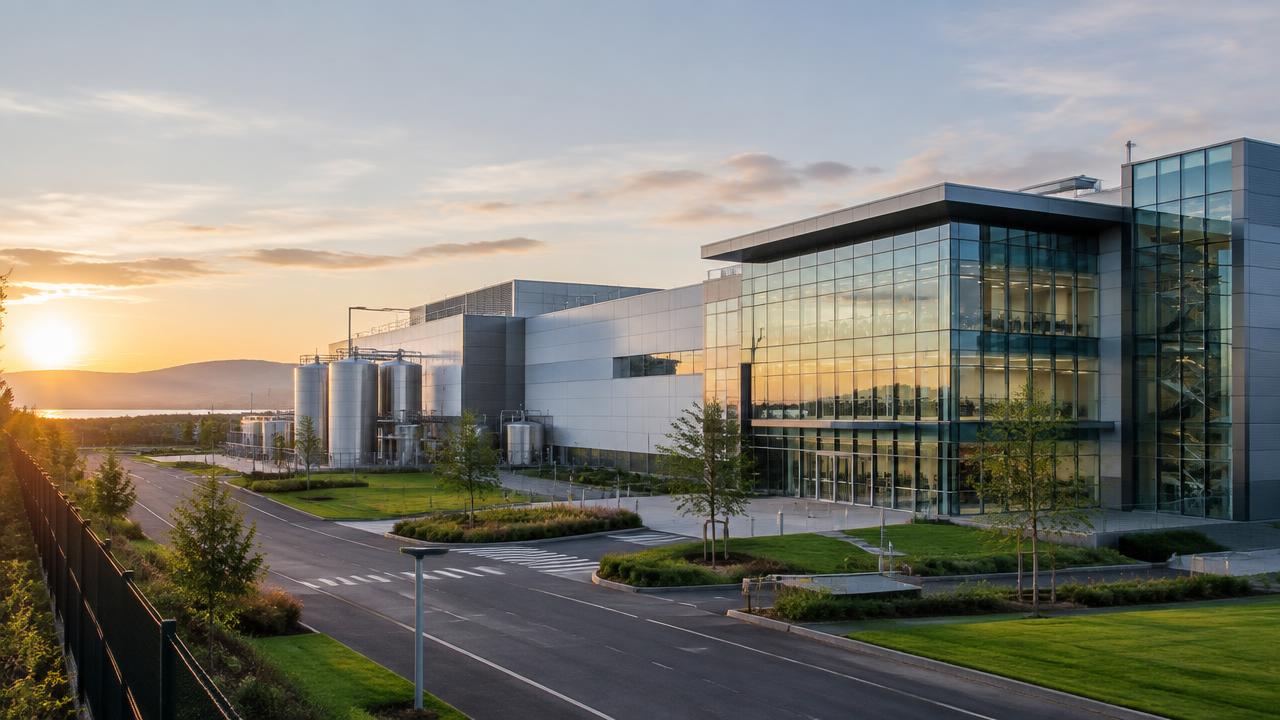
The switch has been flipped at College Park. On the Alexion Campus in Dublin, AstraZeneca has brought online a new $360 million facility built to make the active pharmaceutical ingredients behind some of its next cancer medicines. The opening in May 2026, more than three years after construction began, caps one of the company's most closely watched Irish investments and adds around 100 new specialist jobs to its Dublin operations, with visiting UK government ministers joining senior Irish figures to formally inaugurate the plant.
From announcement to opening
AstraZeneca first floated plans for a next-generation active pharmaceutical ingredient, or API, facility for small molecule medicines in Dublin back in 2021, with an initial commitment of around €300 million. Company filings with the Companies Registration Office later showed AstraZeneca had pumped a total of $3.5 billion into its Irish subsidiary, AstraZeneca Ireland Limited, as it built out the project, according to reporting by The Currency in January 2025.
By July 2025 the company confirmed the synthetic drug substance commercialisation facility remained on schedule for completion in 2026, even as its US parent group unveiled a much larger $50 billion investment plan for American manufacturing. AstraZeneca told the Irish Examiner the Dublin plans were unaffected by the US announcement, and construction carried on regardless.
That promise was delivered in May 2026, when AstraZeneca officially opened the $360 million facility at its Alexion Campus, with executive vice president for global operations Pam Cheng describing it as 'an innovative and unique asset in our global operations network.'
The opening ceremony itself underlined how closely Ireland and the UK are entwined in AstraZeneca's supply chain: it was inaugurated by the UK's Minister for Defence Readiness and Industry, Luke Pollard, with fellow UK MP Claire Hazelgrove also attending, alongside Taoiseach Micheál Martin [1](https://www.madein.ie/content/news/astrazeneca-opens-360m-api-manufacturing-facility-in-dublin).
What the new plant does
The facility produces small molecule active pharmaceutical ingredients for late-stage development and early commercial supply, built specifically to support AstraZeneca's growing oncology pipeline as well as its wider medicines portfolio. It leans on advanced automation and artificial intelligence tools that the company says improve speed, flexibility and sustainability in how new therapies are manufactured and brought to patients.
Around 100 direct jobs have been created at the site, mostly for scientists and engineers, with further indirect employment expected to follow in the surrounding supply chain. IDA Ireland, the state's inward investment agency, backed the project.
AstraZeneca's own recruitment material describes the facility as a 'digital smart and paperless factory' designed to manufacture APIs continuously rather than in the more traditional batch-by-batch way, a shift the company says will let it deliver medicines to patients faster, more cheaply and more sustainably [3](https://careers.astrazeneca.com/apicomdublin). Site lead Jon-Paul Sherlock has described the Dublin plant as putting the company 'at the forefront of Ireland's pharmaceutical manufacturing ecosystem' [3](https://careers.astrazeneca.com/apicomdublin).
The site is also building out a dedicated Chemical Development laboratory, co-located with the commercial facility, to lead late-stage process characterisation and tech transfer for AstraZeneca's small molecule medicines. Recruitment for that team, which reports into AstraZeneca's global Chemical Development organisation based in Macclesfield, continued into 2026, with a Director-level hire advertised in February to help define standards and systems the company expects to eventually scale across its wider API portfolio [4](https://careers.astrazeneca.com/job/dublin/manufacturing-science-and-commercial-supply-director/7684/81251902400).
That continuous manufacturing approach also makes the facility more adaptable: rather than retooling an entire batch process to switch between products, AstraZeneca says the digital, paperless design lets teams reconfigure production more quickly, a feature the company expects to matter as its oncology pipeline brings a growing number of small molecule medicines through late-stage development at the same time.
A vote of confidence amid global trade uncertainty
The timing of the opening was notable. It came as pharmaceutical companies with large Irish operations faced continued uncertainty over potential US tariffs on medicine imports, a pressure that had already pushed AstraZeneca to commit tens of billions of dollars to expanding its American manufacturing base.
Against that backdrop, Taoiseach Micheál Martin called the Dublin facility 'a significant vote of confidence in Ireland's life sciences ecosystem and in the highly skilled people who work across the sector,' while IDA Ireland chief executive Michael Lohan said the investment 'underlines Ireland's strength in advanced manufacturing, innovation and talent' and would help strengthen the resilience of global supply chains.
AstraZeneca's own figures put the scale of its ambition in context: the group is targeting $80 billion in global revenues by 2030, with half expected to come from the US market, meaning its manufacturing footprint in places like Dublin plays a supporting role in a much bigger worldwide growth push, not a competing one.
Engineers Ireland reported that the Dublin facility 'demonstrates how advanced automation, AI, and innovative new technologies push the boundaries of science and manufacturing,' a description that fits a broader pattern across Ireland's pharma sector in 2025 and 2026, where new plants are increasingly framed as digital-first sites rather than simply larger versions of existing ones [5](https://www.engineersireland.ie/Engineers-Journal/News/astrazeneca-opens-api-manufacturing-facility-in-dublin).
What it means for Ireland's life sciences sector
The Dublin API plant adds to a cluster of major biopharma investments in Ireland in 2025 and 2026, reinforcing the country's role as what Euractiv described as 'a critical node' in global pharmaceutical supply chains at a moment of heightened trade uncertainty.
For AstraZeneca specifically, the Alexion Campus now combines its existing rare disease operations with a state-of-the-art small molecule API facility, giving the company two distinct manufacturing capabilities on a single Dublin site and a stronger case for further investment as its oncology portfolio expands.
The new plant also means AstraZeneca now needs a wider range of skilled workers on the same campus, from API technicians and warehouse operatives to automation and process engineers and quality assurance staff, roles the company has continued to advertise for through 2026 as it builds out a permanent operating team rather than a purely construction-era workforce [3](https://careers.astrazeneca.com/apicomdublin).
Building out a permanent operating team in 2026
Recruitment at the Alexion Campus has continued well past the plant's official opening. Through the second half of 2026, AstraZeneca advertised senior roles including a Director, BDS Manufacturing Operations Lead based at College Park, reporting into the site's Operations Leadership Team and tasked with steering upstream and downstream biologics manufacturing through to product release, and a Senior Maintenance Engineer post in September 2026 to help embed maintenance and reliability principles into the newly commissioned facility as it moves from construction into steady commercial operations [4](https://careers.astrazeneca.com/job/dublin/senior-maintenance-engineer/7684/100434896016).
AstraZeneca's Alexion careers page listed 22 open roles based in Dublin during 2026, spanning categories from AI science and engineering to quality control, data engineering, and safety, health and environment, underlining that the campus's hiring needs now extend well beyond the API plant itself into wider digital and operational functions [3](https://careers.alexion.com/ireland-jobs).
The company has also created a dedicated Communications and Sustainability Director role for its Irish Alexion Operations, tasked with setting measurable sustainability goals across the site and reporting on progress, a sign AstraZeneca sees its Dublin campus as a long-term flagship for both manufacturing output and environmental performance rather than a project that ends once construction wraps up [1](https://careers.astrazeneca.com/job/dublin/alexion-operation-and-sustainability-communications-director-ireland/43991/86237063216).
That pattern of continued senior hiring, well after a ribbon has been cut, mirrors how other major Irish pharma sites have transitioned from construction projects into fully staffed operations, and points to the Alexion Campus adding headcount steadily through 2026 and beyond as its API and biologics teams both mature.
The Bottom Line
AstraZeneca's new $360 million facility at the Alexion Campus has gone from a €300 million announcement in 2021 to a fully operational plant in 2026, on schedule and creating around 100 highly skilled jobs, even as the company simultaneously commits tens of billions of dollars to expanding in the United States. For Dublin, that is proof Ireland can still win and deliver large-scale pharmaceutical manufacturing investment in a genuinely competitive global market.
Health Pulse — Ireland's home for health and healthcare intelligence. Subscribe to the Pulse Network Briefing.