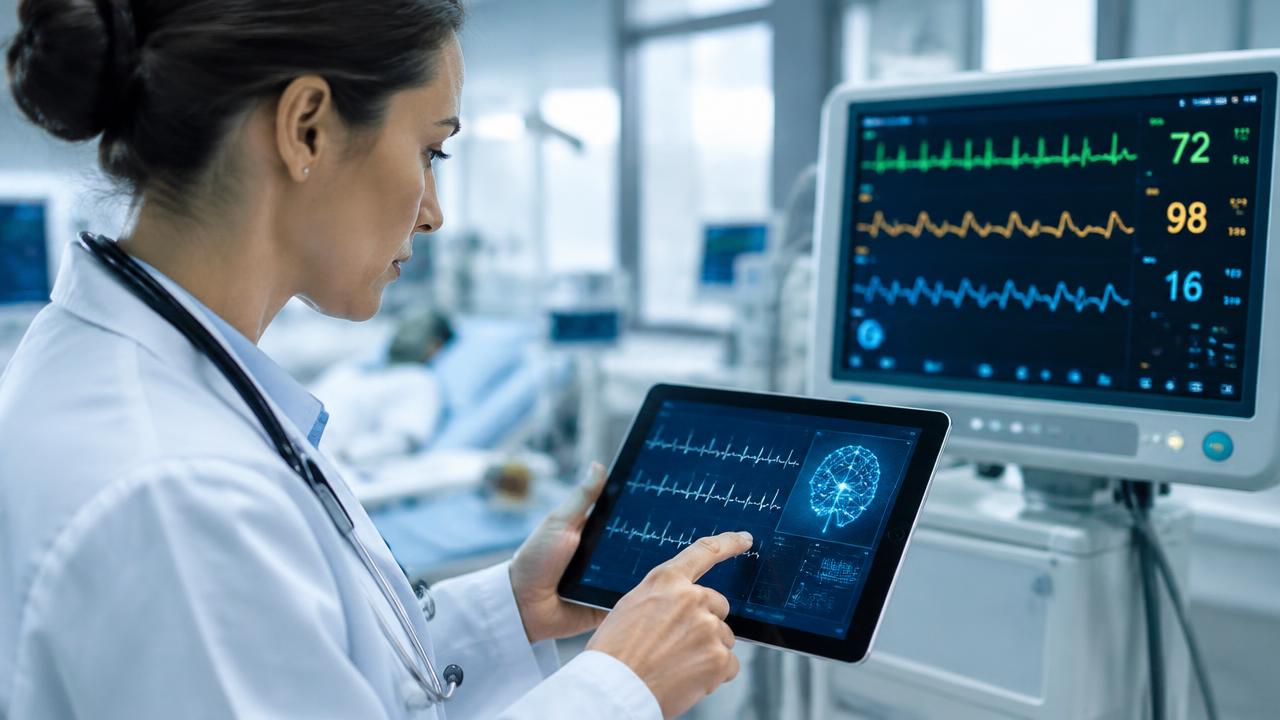
An ECG that once took a specialist minutes to read can now be scanned by software in seconds, and in Irish cardiology that shift is no longer theoretical. Between 2025 and 2026, Ireland published its first national plan for health AI, Galway researchers pushed heart-rhythm algorithms onto pocket-sized hardware, and Irish-linked cardiac device firms pulled in tens of millions in fresh investment. None of it is a single dramatic breakthrough. Together, though, it adds up to artificial intelligence quietly becoming part of how Irish hearts are screened, mapped and monitored.
A national strategy built around real use cases
The starting point came in March 2026, when Minister for Health Jennifer Carroll MacNeill launched 'AI for Care', Ireland's first national strategy for artificial intelligence in health and social care, running from 2026 to 2030. The HSE describes it as setting out 'a clear and coordinated vision for using AI to improve patient outcomes and support staff, and to ensure AI is used safely and sustainably'.
It builds on infrastructure already in place, including the One Health Record and the HSE Shared Care Record, and rests on six guiding principles, among them that AI must be 'person-centred' and 'transparent and trustworthy'. That matters for cardiology in a very practical way: reading ECGs and imaging faster can change outcomes, and quick, AI-assisted decisions are exactly what the strategy is designed to support.
The HSE's National Service Plan 2026 backs that up, naming cardiovascular care as one of its specific clinical priorities for the year, alongside further rollout of the Shared Care Record and expansion of the Maternity and Newborn Electronic Health Record. Putting cardiovascular care and AI-ready digital infrastructure in the same annual plan is a fairly clear signal: officials expect heart services to be among the first to benefit from better data and smarter tools.
Getting the trust and safety piece right matters just as much as the technology itself. The strategy's insistence on AI being transparent and sustainably used reflects hard lessons learned elsewhere, where clinicians have grown wary of 'black box' tools that flag a result without explaining why, and where hospitals have had to build entirely new governance structures just to decide which AI tools are safe to use at the bedside.
The Department of Health has been specific about the everyday gains it expects: certified AI tools that let radiologists read X-rays, CT scans and MRIs faster and catch strokes, cancers and fractures earlier, plus AI scribe tools that the Department says can cut clinicians' documentation time by up to 40%. That freed-up time is time cardiologists could spend with patients instead of paperwork.
Irish research groups building the AI-ECG evidence base
At University of Galway, cardiovascular researchers working with international partners published a study in April 2026 on a compressed-learning framework that classifies arrhythmia, congestive heart failure and normal heart rhythm directly from compressed ECG signals, a deep-learning approach built to run efficiently on low-power hardware. The team, which included Galway's Derek O'Keeffe, reported accuracy of up to 96.56% and validated the framework on embedded microcontroller hardware, a real step towards AI-ECG analysis running in real time on small, wearable-scale devices.
The focus on low-power hardware is a deliberate choice, not a technical curiosity. Running the model on a cheap, small microcontroller, rather than shipping raw ECG data off to a hospital server or the cloud, means a wearable patch or portable monitor could flag an abnormal rhythm in real time in a patient's own home, without a constant internet connection or expensive processing power. That is especially useful for rural areas or for patients who cannot easily travel for monitoring.
Galway's cardiovascular research group, led by Professor Faisal Sharif and supported by CÚRAM, the Research Ireland centre for medical devices, has also been developing and testing new remote heart failure monitoring technology, including a 2025 pre-clinical study using a porcine model to validate a novel implantable monitoring device ahead of clinical development. CÚRAM itself, headquartered at University of Galway, has become one of the country's main hubs for this kind of applied cardiac device research, pairing engineering and materials science expertise with clinical cardiology teams so new monitoring devices are tested against real physiological data from an early stage.
Long-running AF screening work laying the groundwork
None of this newer AI work exists in a vacuum. It sits on top of years of Irish clinical screening research into atrial fibrillation (AF), the most common heart rhythm disorder and a major stroke risk factor. A University College Cork-led pilot of opportunistic AF screening in Irish general practice, run with the Irish College of General Practitioners and the HSE and published in Open Heart in 2024, tested pulse checks followed by ECG confirmation as a practical way of catching undiagnosed AF before it causes a stroke.
That matters because AF so often hides in plain sight: international trial evidence cited in the Irish research shows around 45% of stroke patients later found to have atrial fibrillation had no previous diagnosis, meaning their first sign of the condition was the stroke itself, not a routine check-up. Catching AF early and starting patients on oral anticoagulant medication is associated with cutting stroke risk by up to two-thirds, which is why researchers call closing this diagnosis gap one of the most cost-effective opportunities in Irish cardiovascular care.
That kind of structured screening data is exactly what AI-ECG algorithms need to be trained and validated on, and it lines up with Ireland's broader National Cardiovascular Policy recommendation to establish AF screening more widely, a goal AI-assisted tools are now being built to support at greater scale. A separate Health Research Board-funded trial, the Community Risk-based monitoring for Atrial Fibrillation Trial, is testing a two-step, risk-based approach to catching the harder-to-spot paroxysmal form of AF, which comes and goes and can easily slip past a single ECG taken on one day, precisely the pattern continuous, AI-assisted monitoring is well suited to picking up.
Irish-linked cardiac technology attracting serious investment
Investors are backing this direction with real money. CroíValve, a Trinity College Dublin medical device spin-out with a research base at the ATU iHub in Galway, closed a $20 million Series B expansion in mid-2026, taking its total Series B funding to $36 million and $43 million including grants, to expand clinical trials of its minimally invasive tricuspid valve device across the US and Europe.
Separately, precision cardiac mapping company CoreMap closed a €37 million Series C round in 2026 to refine electroanatomical mapping technology used to guide catheter ablation for atrial fibrillation, aiming to improve on the 60-80% first-procedure success rates typical of ablation today, according to industry analysis published in July 2026. The Irish Heart Foundation estimates roughly 70,000 people in Ireland live with atrial fibrillation, a number that keeps growing every year.
Rounds like these matter beyond the individual companies. They reflect investor confidence that Irish-linked cardiac technology, developed with input from Irish universities and clinical research centres, can compete for international patients and international capital. They also tend to keep skilled engineering and clinical research jobs at home, since companies raising large funding rounds typically grow their existing research and development teams rather than starting fresh elsewhere.
Hospitals putting AI to work at the bedside
Adoption is starting inside hospitals too. In June 2025, the Mater Misericordiae University Hospital in Dublin opened a dedicated Centre for AI and Digital Health, based within its Pillar Centre for Transformative Healthcare, to oversee AI adoption across departments and coordinate research. Consultant cardiologist Professor Joe Galvin said that while a traditional ECG only identifies certain heart attacks in around 40 to 50% of cases, a new AI-powered tool being rolled out in the hospital's cardiology department can identify artery blockages in roughly 90% of patients, potentially doubling the number who receive timely, lifesaving treatment within the critical 90-minute window.
Cross-border collaboration is part of the picture too. In February 2026, Irish cardiac AI company Heart Rhythm International joined Ulster University's €9.1 million PEACEPLUS Health Frontiers Technology Innovation Centre in Belfast as an industry partner, working alongside clinicians and researchers on AI-enabled cardiac rhythm management and connected health infrastructure spanning both sides of the border, building on the company's 17 years of experience running data-driven cardiac services at national scale.
The Bottom Line
There is no single flagship AI product transforming Irish cardiology yet, and nobody claims there is. What is happening is a set of building blocks locking together at pace: a national AI health strategy launched in 2026, University of Galway research pushing AI-ECG analysis onto low-power hardware, established AF screening programmes generating the clinical data AI needs to learn from, and Irish-linked cardiac device companies pulling in tens of millions to bring smarter heart monitoring and mapping technology closer to patients. Any one of these on its own would be a modest step. Taken together, they point to AI-assisted heart care becoming standard practice in Ireland well within this decade.
Health Pulse — Ireland's home for health and healthcare intelligence. Subscribe to the Pulse Network Briefing.